

Convertible Footie Pants for Crawling Babies
Table of Contents
- Convertible Footie Pants for Crawling Babies: What Changes at This Stage
- Baby Pants With Fold-Over Feet: How Convertible Cuffs Work
- Baby Pants With Grips on Feet: What the Traction Evidence Shows
- Footed Pants vs. Footless Pants for Babies: Which Suits Crawling
- How to Dress a Baby for Sleep Temperature With Convertible Footies
- Fit, Fabric, and Sizing Across Brands: What to Check Before You Buy
- Frequently Asked Questions
Last Updated: October 5, 2026
Convertible Footie Pants for Crawling Babies: What Changes at This Stage
Convertible footie pants for crawling babies solve a specific problem: once a baby starts moving, traditional footed sleepers become a liability.
At TUMBLE TOES, we built our convertible grip footies around exactly this transition.

Here is what changes at the crawling stage, how fold-over cuffs and grip soles actually work, and how to judge fit, fabric, and durability before you buy.
Baby Pants With Fold-Over Feet: How Convertible Cuffs Work
Baby pants with fold-over feet use a flap of fabric at the ankle that folds over the toes to create a closed foot, or folds back to leave the foot open. The simple mechanism holds up better than complicated systems.
There are two common designs, and they behave differently.
- Fold-over cuffs: the fabric extends past the ankle and rolls or folds over the foot. When open, the foot is bare for grip and airflow.
- Foot flaps: a separate panel snaps or folds down over the foot. More structured, but more hardware to fail.
- Two-way zippers: let you open from the top or bottom, so diaper changes do not require undressing the whole baby.
Fold-Over Cuffs vs. Foot Flaps: A Quick Comparison
Feature |
Fold-Over Cuffs |
Foot Flaps |
|---|---|---|
Coverage when closed |
Full foot |
Full foot |
Speed to open |
Fast, no fasteners |
Slower if snaps involved |
Durability |
High, no hardware |
Depends on snap quality |
Best for |
Crawling, standing, sleep |
Sleep-heavy use |
Diaper access |
Depends on zipper design |
Depends on zipper design |
Both work, but fold-over cuffs stay put better during active play because there is nothing to unsnap. Designs that slip usually have worn elastic or a flap cut too short.
Baby Pants With Grips on Feet: What the Traction Evidence Shows
Baby pants with grips on feet add a textured material to the sole so a crawling or cruising baby has something to push against. Grip soles are a friction aid, not a fall-prevention device.
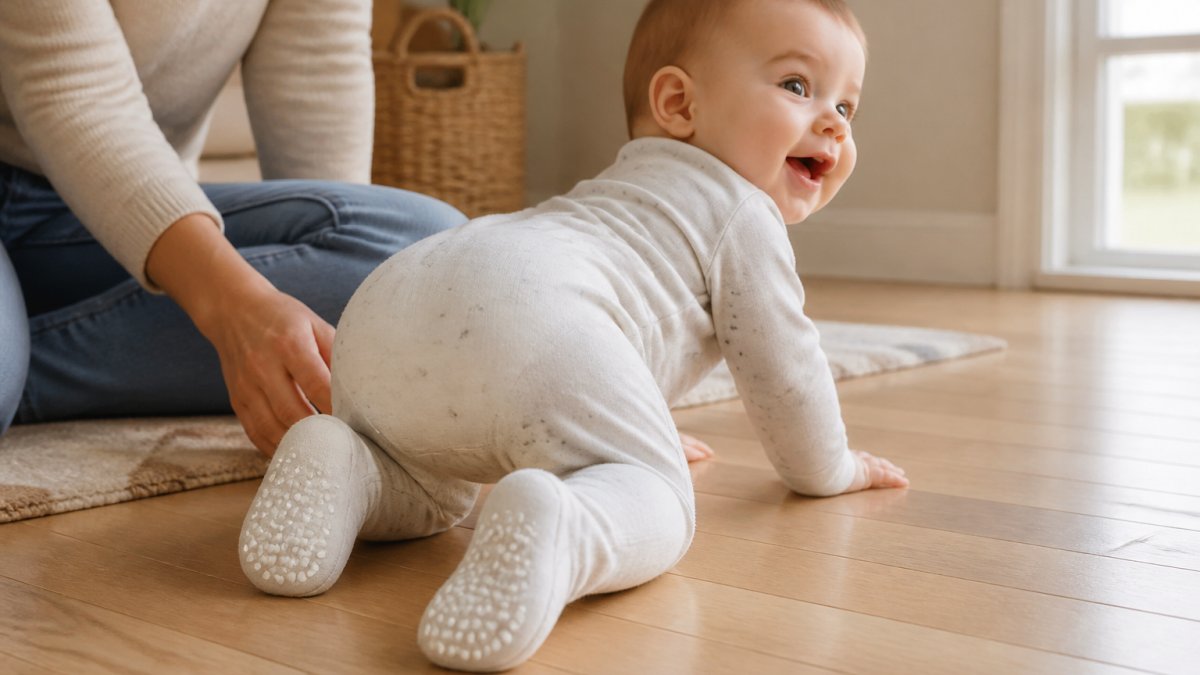
Baby crawling on a hardwood floor wearing footed pants with textured grip soles for added traction
What is well established is simpler: bare feet give a baby the most sensory feedback and the most direct grip. Pediatric physical therapists commonly note that bare-foot time supports foot and ankle development while learning to push, pivot, and pull to stand.
Where grip actually changes the outcome:
- Smooth, hard surfaces (hardwood, tile, laminate): grip soles make the most difference. A bare cotton foot slides; a rubberized sole does not.
- Carpet and rugs: the pile already provides friction, so the marginal benefit is small. Footless pajamas are often better here because toes grip the fiber directly.
- Crib and sleep surfaces: grip is irrelevant. What matters at night is fit and temperature.
How to Check Grip Placement Before You Buy
Grip placement matters more than grip presence. A small heel patch does almost nothing for a crawler, who pushes off the tops of the feet and the balls of the toes. Look for:
- Coverage across the whole sole, from heel to toe, not just one zone.
- A raised, rubberized texture, molded silicone or a printed rubber compound, rather than a flat screen-printed pattern. Flat prints smooth out after a handful of washes and lose most of their friction.
- Grip on the fold-over section itself, so traction survives whether the foot is open or closed. If the grip only sits on the inner foot and the cuff folds over it, the closed configuration has no traction.
A quick test: run a thumb across the sole. If it catches and drags, it will grip a floor. If it glides, it is decoration.
When a Footless Design Beats a Grip Sole
Grip soles are not automatically right for every crawler. A footless convertible, where the fold-over cuff stays open, is often better when:
- Your baby is crawling mostly on carpet or a play mat.
- Your baby runs hot and closed feet lead to sweaty, irritated skin.
- You want maximum sensory input during floor time and are willing to add socks for warmth.
The takeaway: buy a convertible with grip on the fold-over section, then decide daily whether to close the foot.
Footed Pants vs. Footless Pants for Babies: Which Suits Crawling
Footed pants vs. footless pants for babies comes down to one question: does your baby need warmth on the feet, or freedom of movement? Footless wins for active crawling on carpet and babies who run hot.
Situation |
Better Choice |
|---|---|
Cold bedroom, sleeping baby |
Footed or closed convertible |
Crawling on hardwood or tile |
Footless or open convertible with grip |
Baby who removes socks |
Footed or convertible, closed |
Baby who runs hot |
Footless or open convertible |
One garment for day and night |
Convertible |
For a crawler, the convertible design means you are not choosing between the two. You fold the foot down for sleep and fold it back for floor time.
How to Dress a Baby for Sleep Temperature With Convertible Footies
How to dress a baby for sleep temperature starts with the room, not the outfit. Most guidance points to keeping a baby's sleep space between roughly 68 and 72°F (20 and 22°C) and dressing for that temperature rather than adding blankets, which the AAP advises against. Convertible footies make this easier because you can adjust foot coverage without changing the whole outfit. A few rules:
- Warm room, active baby: fold the feet open and use a light sleep sack.
- Cool room, sleeping baby: fold the feet closed.
- Check the back of the neck, not the hands or feet, to judge whether a baby is too warm. Cool hands are normal.
Fit, Fabric, and Sizing Across Brands: What to Check Before You Buy
Fit and sizing across brands is the biggest source of returns in baby sleepwear, because a "6-9M" from one maker is not the same as another. Always measure length, not age. A convertible footie that is too short pulls at the shoulders and pops the fold-over cuffs open; one too long bunches at the ankles and trips a crawler.
How to Measure for a Convertible Footie
Use a soft tape and measure your baby lying flat, from the top of the waist to the base of the heel. That number, not the age on the tag, is what you match to a size chart.
Fabric: What to Look For and What to Skip
Fabric matters as much as fit. Look for soft, breathable materials and a certification that confirms the textile has been tested for harmful substances. OEKO-TEX Standard 100 explained sets limits on substances like formaldehyde and heavy metals in textiles, which is why it matters for babies with sensitive skin.
A short fabric cheat sheet:
- Cotton or cotton-rich blends: breathable, soft, and the default for most babies. Shrinks slightly unless pre-shrunk.
- Bamboo viscose: very soft and moisture-wicking, but can pill and tends to run warmer than cotton.
- Modal or Tencel blends: smooth, durable, and good for sensitive skin; usually pricier.
Sizing Across Brands: Why the Tag Lies
There is no mandatory sizing standard for baby sleepwear, so a "9M" is whatever that brand decides it is. Ignore the age range and compare the brand's length chart to your baby's shoulder-to-heel measurement.
Our Convertible Grip Footies come in 3-6M through 18M, with a length-based size chart so you can match the garment to your baby's actual measurement:
Size |
Length |
|---|---|
3-6M |
15" |
6-9M |
16" |
9-12M |
17" |
18M |
18" |
For an 18-month-old who is constantly moving, the fold-over design still works. The cuff folds back for grip during play and closed for sleep. What changes with an active toddler is the fit priority: room to kick and a close fit through the torso matter more than length alone.
Cost Per Wear: The Number That Actually Matters
A convertible footie usually costs more than a basic footed sleeper, so the fair comparison is cost per wear, not sticker price. Rough math: a $30 convertible footie worn three nights and two days a week for six months is roughly 130 wears, about 23 cents per wear. A $12 basic sleeper that only works for sleep and gets outgrown in three months costs more per wear, and it does not replace the daytime outfit you would otherwise buy. Variables that move cost per wear:
- How long the size lasts. A length-based chart that lets you size up and use the open foot extends the wear window.
- How well it survives washing. A garment that shrinks out of fit after ten washes has a short life no matter the price.
- How many jobs it does. One garment that covers sleep, floor time, and diaper changes replaces two or three purchases.
Care, Shrinkage, and Long-Term Durability
Care and shrinkage decide whether a convertible footie survives past a few washes. Cotton can shrink, and even slight shrinkage can shorten the garment enough to pull the cuffs open.
- Wash cold to limit shrinkage and protect the grip texture.
- Skip the dryer or use low heat. High heat is the main cause of shrinking and stretched cuffs.
- Close the fold-over cuffs before washing so they do not snag.
Our footies are OEKO-TEX® Standard 100 certified, meaning the supplied materials have been tested for harmful substances, the concrete answer for parents weighing whether certification is real or marketing.
Frequently Asked Questions
Are convertible footie pants good for crawling babies?
They can be, mainly because of the fold-over foot design. You can cover the feet for warmth, then fold the covers back so bare feet or grip soles contact the floor during crawling practice. Grip traction on the foot covers also helps on smooth surfaces like hardwood or tile. If your baby is pulling to stand or cruising, check that the feet are not baggy, since loose fabric can bunch under the toes and cause slips. The Tumble Toes Co. Convertible Grip Footies ($32.99) are built around this fold-over design with textured grip details.
Do babies need grippers on their pants to crawl?
Not strictly. Crawling develops through floor time, tummy time, and practice, and many babies crawl fine in bare feet. Grippers matter most on smooth flooring, where footed pants can slide. If your baby spends crawling time on hardwood, tile, or laminate, foot grips give better purchase than plain fabric soles. If your home is mostly carpet, the benefit is smaller. Either way, fit matters more than grip: pajamas that are too long in the leg will bunch and trip a crawler regardless of the sole.
How should footie pants fit a baby who is crawling?
A close fit with room to kick is the goal. The fabric should lie flat against the leg without pulling at the crotch or bunching at the knee, and the foot should sit flush against the toe without extra fabric. Check length against the brand's size chart rather than age alone, since sizing varies widely between brands. Tumble Toes Co. lists a size chart of 15 inches at 3-6M, 16 inches at 6-9M, 17 inches at 9-12M, and 18 inches at 18M. If your baby is between sizes, size up only if the foot section still fits snugly.
What temperature is right for a baby wearing footie pants?
Most guidance points to a room around 68 to 72 degrees Fahrenheit for sleep, with babies dressed in one layer plus a sleep sack if needed. Footie pajamas count as that layer and cover the feet, so you usually do not need socks underneath. If the room runs warmer, choose a lighter fabric or fold the foot covers back to release heat. If it runs cooler, keep the feet covered and add a sleep sack rather than extra blankets, which are not recommended for infants.