

How to Choose Non Slip Socks for Babies Learning to Walk
Table of Contents
- Why Traction Matters for Crawling, Standing, and First Steps
- How to Assess Grip Quality in Person
- How Should Baby Socks Fit?
- Baby Grip Socks vs. Barefoot: What the Evidence Says
- What Shoes Should Babies Wear When They Start Walking?
- Thickness, Flexibility, and Freedom of Movement
- Care, Washing, and Grip Longevity
- Safety Limits and When to Supervise Closely
- Frequently Asked Questions
Last Updated: October 9, 2026
Why Traction Matters for Crawling, Standing, and First Steps
Learning to choose non slip socks for babies learning to walk starts with understanding one simple idea: traction is about confidence, not just safety. When a baby's feet slide on hardwood or tile, they tense up.
Smooth surfaces give new walkers almost nothing to push against. Socks with grippy soles give them a bit of hold, so each wobbly step feels more stable.
Crawling babies use grip too. They push off with their feet when scooting toward furniture, and slippery socks make that harder.
Here at Tumble Toes Shop, we hear from parents every week who watch their baby slip once and then refuse to try again for days. That pause matters. Practice is how walking gets built.
A few floor types to think about:
- Hardwood and tile: the slickest, where grip helps most
- Laminate: similar to hardwood, often a little smoother
- Carpet: naturally grippy, so sock choice matters less
- Rugs over hard floors: mixed, so a full-sole grip works best
The goal is not to prevent every fall. It is to give your baby enough grip to keep trying.
How to Assess Grip Quality in Person
Most product pages describe grip as "non-slip" and leave it at that. But grip quality varies widely, and you can judge it in about a minute with your own hands. Here is a practical checklist you can run in a store aisle or at your kitchen table.
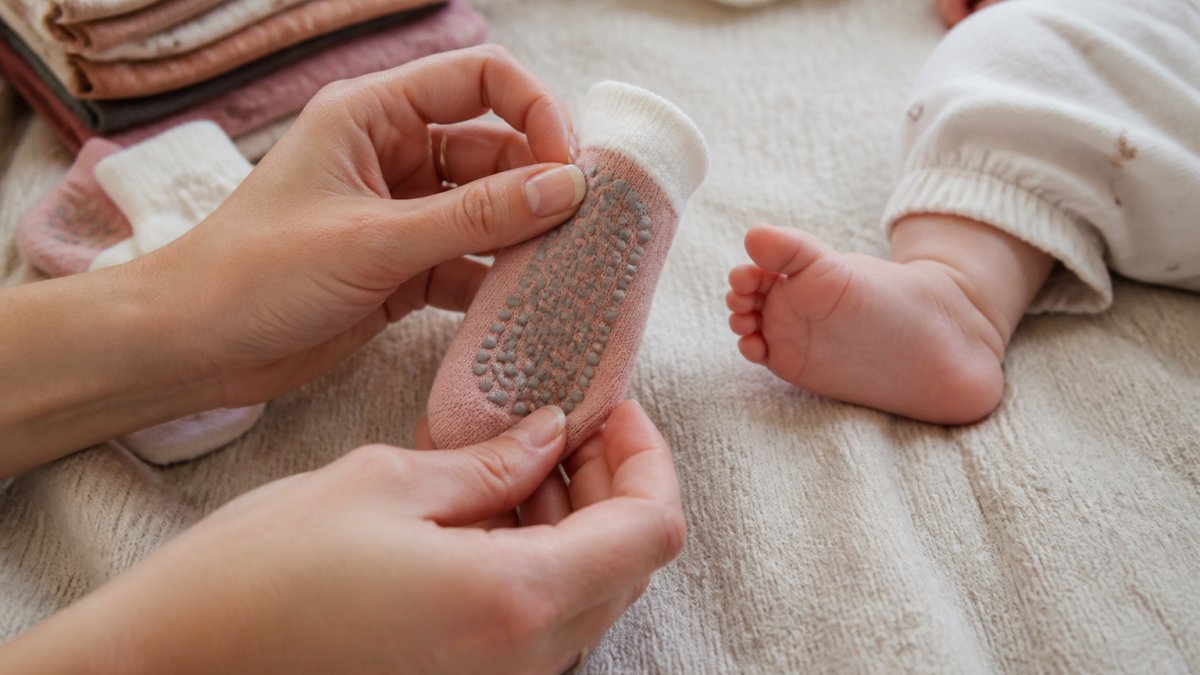
The Five-Point Grip Check
1. Coverage: where does the grip actually sit? Flip the sock over.
2. Spacing: are the grips close enough to matter? Wide gaps between grips mean more bare fabric touching the floor. Run your finger across the sole.
3. Flexibility: does the grip move with the foot? Bend the sock in half and twist it. The grip material should flex without cracking or peeling at the edges.
4. Traction: test it on the surfaces you actually have. This is the step most parents skip. Take the sock and press it against a clean, dry sample of your floor.
5. Raised profile: do the grips still stand up? Press your thumb firmly into the sole and release. The grips should spring back and remain raised.
What to Avoid
- Grips only at the toes or only at the heel
- Sparse dots with large bare patches between them
- Grips that feel hard, brittle, or slick to the touch
- Patterns that peel or crack when you bend the sock
- Any grip that slides freely on your actual floor
A Note on Grip Pattern and Coverage
Pattern matters more than total grip amount. A sock with a few large circles may have less usable contact area than one with many small, evenly spaced grips. The goal is consistent contact across the whole sole, so that wherever your baby's weight shifts, some grip is there to meet the floor.
If you are comparing two socks and both pass the five-point check, choose the one with the denser, more uniform pattern. That is the one that will hold up best as your baby moves from crawling to pulling up to taking those first independent steps.
How Should Baby Socks Fit?
A well-fitting sock stays put without squeezing. That means snug at the heel, roomy at the toes, and no gap around the ankle.
Fit is the most common reason grip socks fail. A sock that slides down turns into a hazard, because the grip ends up under the arch instead of the sole.
Toe Room, Heel Placement, and Stay-On Fit
Check three things every time you put socks on:
- Toes: about a fingertip of room at the end, no bunching
- Heel: the heel cup sits on the heel, not halfway up the ankle
- Ankle: snug enough that the sock does not slide when your baby pulls
If the heel rides up, the sock is too big. If the toes curl under, it is too small. Growing feet change size fast, so recheck fit every few weeks.
Baby Grip Socks vs. Barefoot: What the Evidence Says
Barefoot is widely considered the gold standard for early walking. When a baby feels the floor directly, their feet send detailed feedback to the brain about balance, weight distribution, and surface texture. Many pediatric physical therapists suggest bare feet indoors when the floor is safe and warm, because the foot learns faster with nothing in the way.
But barefoot is not always practical. Cold floors, daycare rules, and smooth surfaces that offer no traction can make socks the better choice. The key is knowing when each option fits.
A Developmental-Stage Decision Guide
Use this guide to match the choice to what your baby is actually doing right now.
Crawling (typically 6-10 months)
- Barefoot: best on carpet, rugs, or warm, clean floors. Direct contact helps with pushing off and building leg strength.
- Grip socks: useful on hardwood, tile, or laminate, where bare feet can slide during scooting and pulling. Look for full-sole grip so the feet catch when pushing toward furniture.
- Shoes: not needed indoors. Skip them unless a healthcare provider recommends otherwise.
Pulling to stand (typically 8-12 months)
- Barefoot: still preferred on safe, warm surfaces. Standing practice builds ankle strength and balance.
- Grip socks: helpful on smooth floors where bare feet slip. The grip gives a stable base as your baby learns to shift weight from both feet to one.
- Shoes: avoid indoors. A stiff sole limits the ankle movement this stage depends on.
Early independent steps (typically 9-15 months)
- Barefoot: ideal indoors on carpet or rugs. The foot can spread and grip naturally.
- Grip socks: the practical middle ground on hardwood, tile, and laminate. Thin, flexible socks with full-sole grip let the foot bend while adding traction.
- Shoes: reserve for outdoors on rough or cold ground. Choose flexible, flat, lightweight shoes with a wide toe box.
Daycare or group care settings
- Grip socks: often required or strongly preferred because floors are shared and often smooth. Check whether the facility has specific requirements.
- Barefoot: may not be allowed for hygiene or safety reasons.
- Shoes: usually kept for outdoor play only.
Home with mixed flooring
- Grip socks: the most versatile choice. A full-sole grip works on hardwood, tile, and laminate, and does not hurt on carpet.
- Barefoot: fine on carpet and rugs, but you may want socks for the hard-floor areas.
What the Evidence Suggests
The American Academy of Pediatrics guidance on infant movement emphasizes free movement and supervised floor time as the real drivers of motor development, not footwear. Grip socks are an assist, not a substitute for practice or supervision.
A common pattern practitioners describe: babies who slip once on a smooth floor often hesitate to try again for days. That pause can slow the practice that builds walking. Grip socks reduce that risk without restricting the foot the way shoes can.
The Bottom Line
- Choose barefoot when the floor is warm, clean, and safe.
- Choose grip socks when the floor is cold, smooth, or shared.
- Choose shoes only for outdoors and rough ground.
- Always supervise, and treat grip socks as a small assist, not a safety device.
What Shoes Should Babies Wear When They Start Walking?
The best first shoes for new walkers are flexible, flat, and light. A stiff sole blocks the foot from bending, which is exactly what a new walker needs to do.
Look for these features:
- A sole that bends easily in your hand
- A flat heel with no lift
- Lightweight materials
- A wide toe box so toes can spread
Skip anything with a thick, rigid sole or a raised heel. Those are for older kids, not first steps.
Indoors, most babies do better in socks or bare feet. Save the shoes for outside, where the ground is rough or cold. If you want a middle option, our Convertible Grip Footies have fold-over foot covers, so you can cover the feet for a trip outside and fold them back at home without changing the whole outfit. You can see the full range at Tumble Toes Shop convertible grip footies.

Thickness, Flexibility, and Freedom of Movement
Thin socks win for new walkers. A thin, fine-knit sock moves with the foot instead of fighting it.
Thick socks change how the foot meets the floor. They can make a baby feel unsteady, and they bunch up in the toes. If you need warmth, add a layer on the body, not on the feet.
Flexibility is the point. A sock should bend and twist as easily as the foot inside it. Test it by rolling the sock in your hand. If it feels stiff, it will feel stiff on your baby too.
Care, Washing, and Grip Longevity
Grip wears out. Rubberized grips pick up lint, lose their texture, and flatten with heat. A few habits keep them working longer.
- Turn socks inside out before washing
- Use cold water and a gentle cycle
- Skip the dryer, or use low heat only
- Avoid fabric softener, which coats the grips
- Air dry flat when you can
Check the soles every few weeks. Once the grips feel smooth to the touch, the sock has lost most of its traction. That is your signal to replace it, not to wait for a hole.
Washability and durability go together here. A sock that survives fifty washes with grips intact is worth more than three cheap pairs that flatten in a month.
Safety Limits and When to Supervise Closely
Grip socks reduce slipping. They do not prevent falls. No sock, and no shoe, can do that.
Watch your baby closely in these situations:
- On stairs, always, no exceptions
- Near hard edges like coffee tables and hearths
- On wet or freshly cleaned floors
- In the bath or anywhere water is present
- On very smooth tile, where even good grips can slide
Also check for wear. A stretched-out sock with flattened grips is worse than no sock, because it slides and bunches at the same time.
Supervision is the real safety net. Grip socks are a helpful tool for a baby who is already practicing, not a replacement for a hand nearby.
Every baby hits the wobbly stage, and the right socks make those first steps a little steadier. At Tumble Toes Shop, we built our Convertible Grip Footies for exactly this window: textured grip on the fold-over foot covers, soft fabric that protects sensitive skin, and OEKO-TEX® Standard 100 certified materials for peace of mind.
Frequently Asked Questions
Do babies need non slip socks when learning to walk?
Non slip socks help on smooth surfaces like hardwood, tile, and laminate where bare feet or regular socks slide easily. They are not a replacement for supervision, and no sock prevents every fall. Many parents use them indoors during crawling, pulling up, and early steps, then switch to barefoot or well-fitted shoes depending on the floor and setting.
How should non slip socks fit a baby?
The sock should hug the foot without wrinkling, with the heel sitting at the back of the ankle and about a half-inch of toe room. Check for bunching at the arch and gaps at the heel, both of which cause slipping. If the sock twists or slides down during crawling, size down or try a different cut. Recheck fit every few weeks because baby feet grow quickly.
Are grip socks safe for babies learning to walk?
Grip socks are safe when they fit well and the grip pattern covers the heel and ball of the foot. They add traction on smooth floors, but they do not replace adult supervision, baby-proofing, or barefoot time for foot development. Inspect grips regularly for wear, and avoid socks with loose threads or peeling rubber that could come off in a baby's mouth.
Should babies wear socks or go barefoot when learning to walk?
Barefoot time on safe indoor surfaces gives babies direct feedback from the floor, which supports balance and foot strength. Socks make sense on cold floors, in daycare settings, or when bare feet are not practical. Many parents alternate: barefoot for play at home, grip socks for cooler rooms or shared spaces, and flexible shoes for outdoor walking.